
Codec Accounting – plain English accounting for charities, small businesses and sole traders in Ealing, West London and across London.
You've set up your business. Before the first invoice goes out, decide where the money will land and how you'll record it.
If you haven't set up yet, start with our guide to setting up a business in the UK.
Keep business and personal money apart
Limited companies. Your company is a separate legal person. GOV.UK says there must be a clear division between the company's finances and those of its owners and directors. The company's banking must be separate from your personal banking. A business bank account is the simplest way to do that.
Sole traders. You might be able to use a personal account for the business. Your bank decides which type of account you can use. Even so, keep a separate account used only for the business, whether it's labelled business or personal. That makes life simpler. HMRC expects you to be able to identify business transactions. That is far easier when they are not mixed with your shopping.
A separate account gives you:
- A clean record. Your bank statement becomes your main business record.
- A clear view of profit. You see what the business earns before you spend it.
- Easier tax returns. You stop sorting personal spending from business costs every year.
Directors: the company's money is not yours. Taking money from a company account is a salary, a dividend, an expense claim or a loan. Each one has its own tax treatment and paperwork. Our article on paying yourself covers the options in detail.
What records to keep
Sole traders
GOV.UK says keep records of:
- all sales and income
- all business expenses
- VAT records, if you are registered for VAT
- PAYE records, if you employ people
- your personal income.
Keep proof: receipts for goods and stock, bank statements, sales invoices, till rolls and bank slips.
Most sole traders can use cash basis, which is now the default. You record income when you receive it and expenses when you pay them. If you opt out and use traditional accounting, you also record what you are owed and what you owe at the year end, plus stock and work in progress. Record your year-end bank balances, money you put in, and money you take out for yourself.
Limited companies
A company keeps two sets of records.
Records about the company: shareholders, votes and resolutions, share purchases, loans or mortgages secured on company assets, debentures and indemnities.
Accounting records:
- all money received and spent
- assets the company owns
- debts it owes and is owed
- stock at the year end, and the stocktakes behind the figure
- goods bought and sold, and who from and to (unless you run a retail business).
Keep the documents behind them too: receipts, orders, delivery notes, invoices, contracts, bank statements and correspondence.
GOV.UK says a company that doesn't keep accounting records can be fined £3,000 by HMRC. Its directors can be disqualified.
How long to keep them
| Sole trader | Limited company | |
|---|---|---|
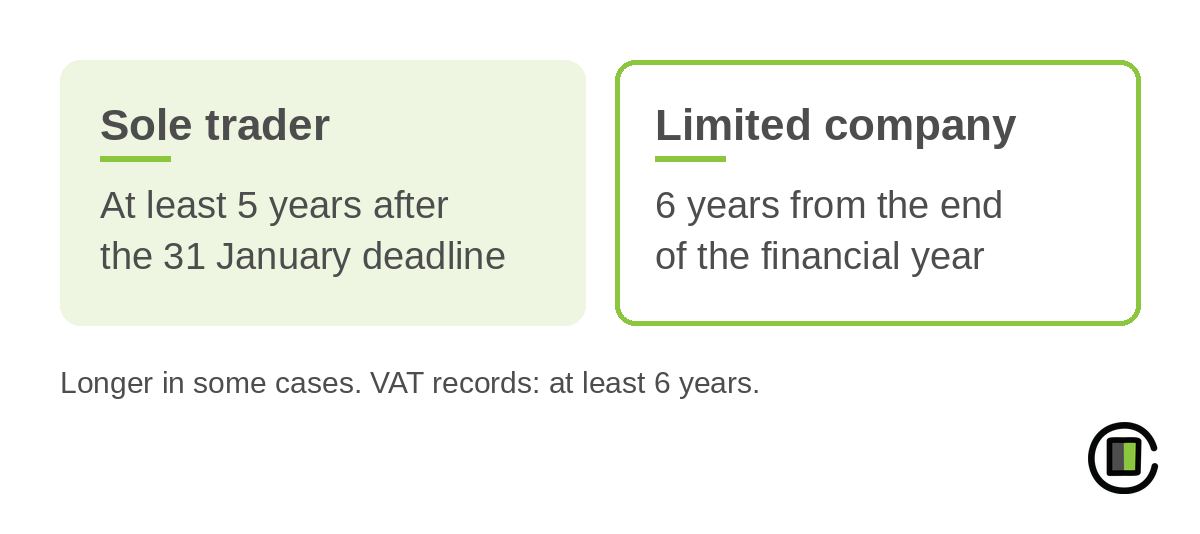
| Minimum period | At least 5 years after the 31 January filing deadline for the tax year | 6 years from the end of the last financial year they relate to |
| Example | 2025/26 return, due 31 January 2027: keep records until at least the end of January 2032 | Year ending 31 March 2027: keep until at least 31 March 2033 |
| Keep longer if | You file more than 4 years late: keep them for 15 months after you send the return | A transaction spans more than one accounting period, an asset is expected to last more than 6 years, the Company Tax Return was late, or HMRC has opened a compliance check |
VAT records follow their own rule: keep them for at least 6 years.
Simple bookkeeping options
Pick the simplest option that fits how you trade.
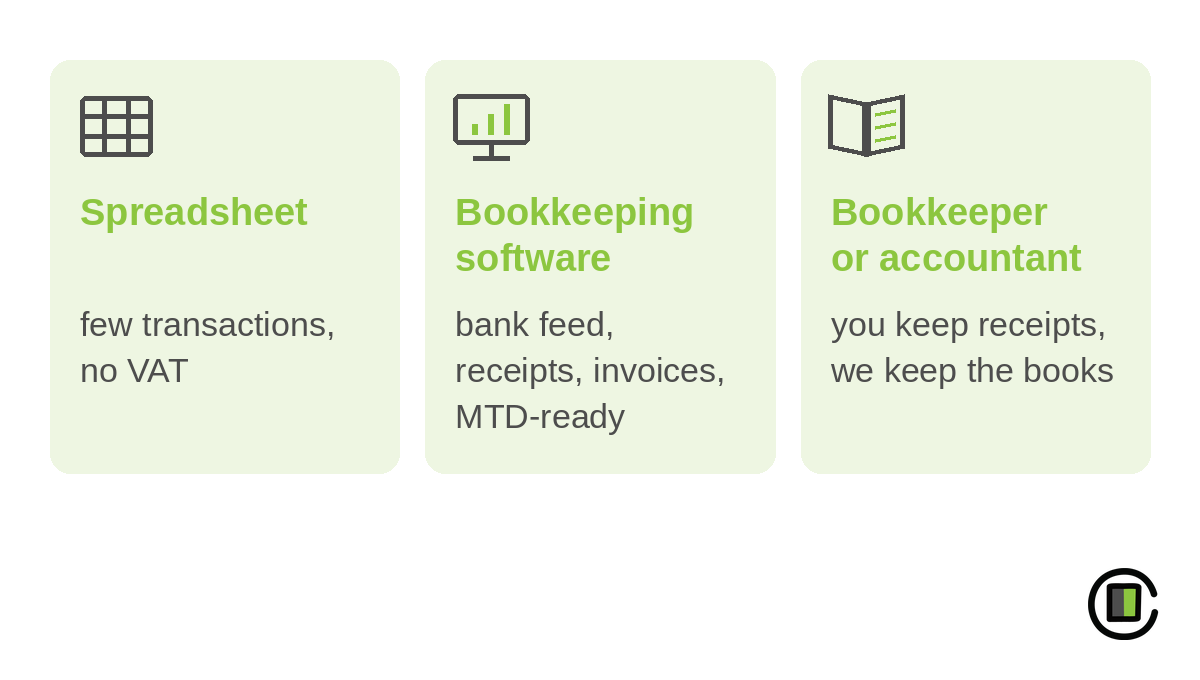
A spreadsheet. It works for a sole trader with a handful of transactions a month and no VAT. List each sale and cost with a date, amount, description and receipt reference.
Bookkeeping software. It connects to your business bank account and pulls in transactions every day. You match each one to a category and attach a photo of the receipt. Invoicing, VAT returns and reports sit in the same place. If Making Tax Digital applies to you, you need compatible software anyway, so start with it and you avoid switching later.
A bookkeeper or accountant. You keep receipts and invoices; we keep the books. This suits directors, anyone registered for VAT, and anyone who would rather spend the time on the business.
Whichever you choose, a few habits make it work:
- Photograph receipts when you get them.
- Reconcile your records with the bank statement every month.
- Keep a short note of anything unusual, such as money you put in or a personal cost paid by mistake.
- Back up digital records.
How Codec Accounting can help
We cover accounting for sole traders and limited companies. We can:
- Set up cloud bookkeeping software linked to your bank account.
- Agree a simple routine for receipts and invoices.
- Keep your books monthly or quarterly.
- Prepare your Self Assessment return or your company accounts and Company Tax Return.
Good records are cheaper to keep than to rebuild. A separate account and a monthly habit from day one save you time and fees at every year end.
Book a meeting, call 0203 143 2772 or contact us to talk it through.
This article is general guidance, not advice for your specific situation. Requirements change, so check current guidance on GOV.UK.