
Codec Accounting – plain English accounting for small businesses, sole traders and charities in Ealing, West London and across London.
Whether you go self-employed or form a limited company, this guide covers what to register, when, and what to watch as you grow. Setting up a business comes down to six steps, in the order they come up.
Figures and deadlines are those on GOV.UK in October 2026. They change from time to time, so check the latest guidance before you act.
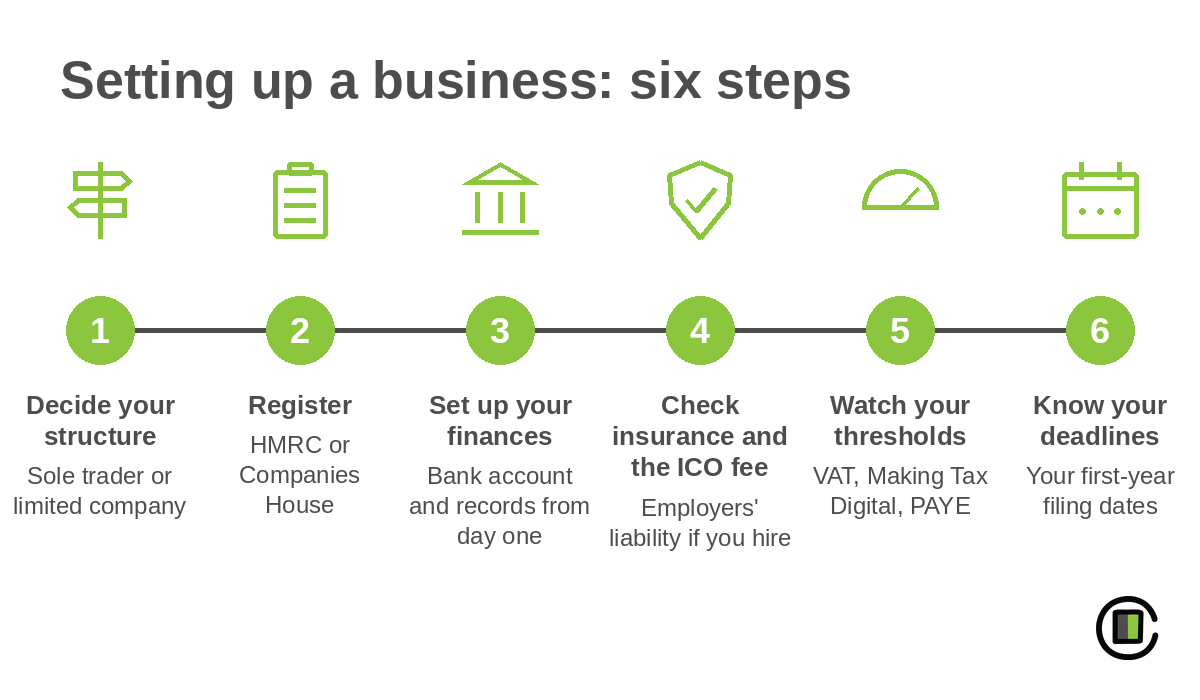
Step 1: Decide your structure
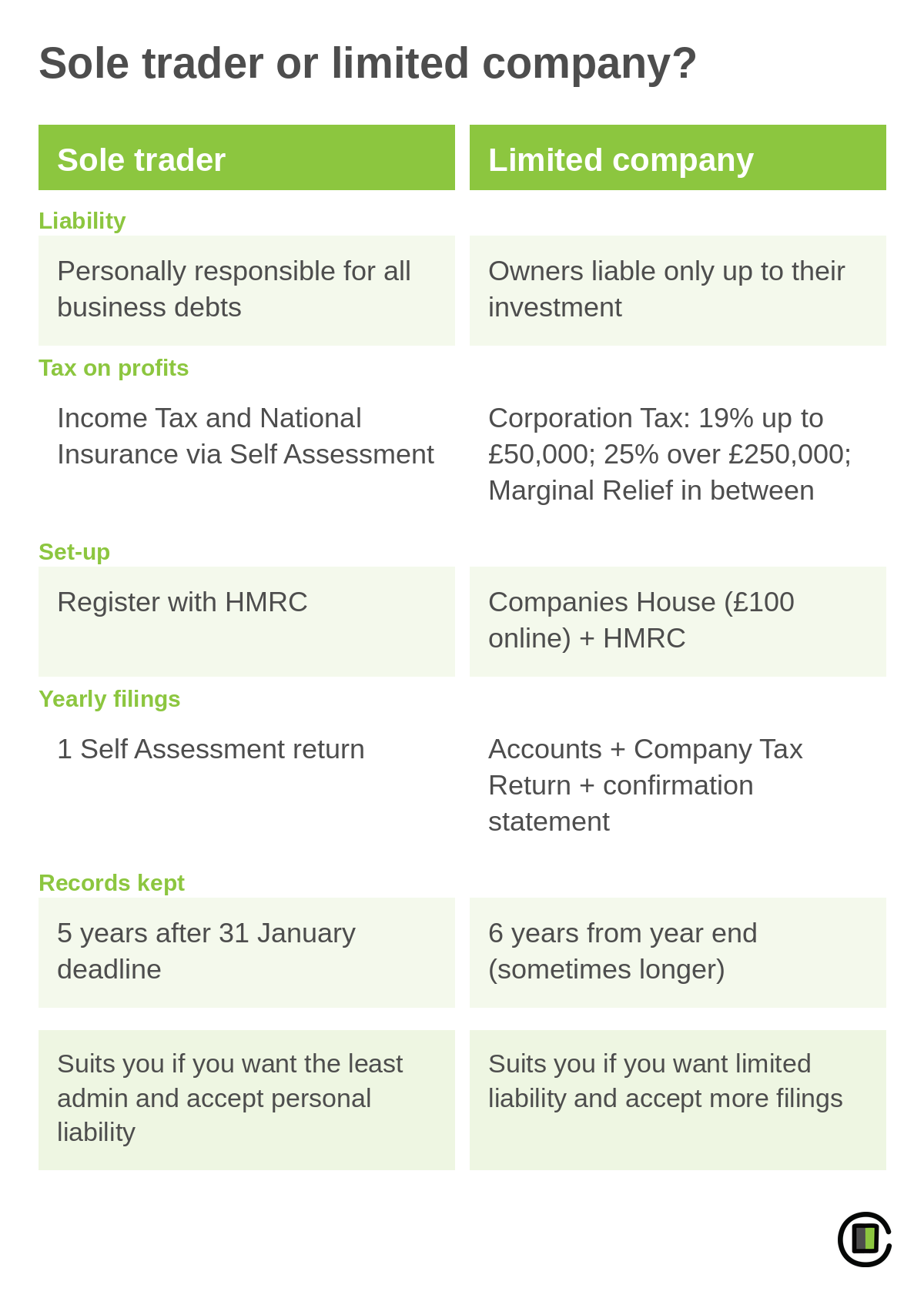
| Sole trader | Limited company | |
|---|---|---|
| Liability | You are personally responsible for all business debts | Owners are liable only up to their investment |
| Tax on profits | Income Tax and National Insurance through Self Assessment | Corporation Tax: 19% on profits of £50,000 or less, 25% over £250,000, Marginal Relief between |
| Taking money out | Profits are yours after tax | Salary, dividends or a director's loan, each with its own rules |
| Set-up | Register with HMRC | Register at Companies House (£100 online) and with HMRC |
| Yearly admin | One Self Assessment return | Annual accounts, Company Tax Return and confirmation statement |
| Records | At least 5 years after the 31 January deadline | 6 years from the end of the financial year (longer in some cases) |
A sole trader suits you if you want the least admin and accept personal responsibility for the business's debts.
A limited company suits you if you want your personal liability limited and accept more filings and rules on taking money out.
Step 2: Register
Sole trader
Register for Self Assessment by 5 October after the end of the tax year you started trading in.
You need to register if your gross trading income is over the £1,000 trading allowance. Late registration can mean a penalty.
Limited company
Register the company at Companies House. Online registration costs £100 and usually takes 24 hours.
HMRC then sends your company's 10-digit Unique Taxpayer Reference (UTR). If it has not arrived after 15 working days, request it online.
When the company starts to do business (buying, selling, advertising, renting a property or employing someone), add Corporation Tax services to your business tax account.
Tell HMRC within 3 months of the start of that first accounting period.
Step 3: Set up your finances
Bank account. GOV.UK calls a business bank account the simplest way to keep company finances separate. Sole traders may be able to use a personal account; your bank decides.
Records from day one. Keep every sale, income and expense, for the periods in Step 1. A company that fails to keep records can be fined £3,000 and its directors disqualified. Pick software that works with Making Tax Digital (Step 5).
Step 4: Check insurance and the ICO fee
Insurance
Employers' liability is compulsory once you employ anyone (close family only, or staff outside Great Britain, are exempt). Minimum cover £5 million, from an authorised insurer. You can be fined £2,500 for every day you are not insured. You must display the certificate; you could be fined £1,000 if you do not.
Public liability covers injury or property damage to the public. Needed if you work with the public or a contract requires it.
Professional indemnity covers claims that your advice or services caused a client financial loss.
Motor insurance is a legal requirement if you use a vehicle for business, including your own vehicle.
ICO data protection fee
If you use personal information, including as a sole trader, you pay the Information Commissioner's Office a fee unless exempt. Tier 1 (turnover up to £632,000 or no more than 10 staff) is £52, or £47 by direct debit. Using data only for staff administration, your own marketing, or accounts and records is exempt. The ICO's online self-assessment confirms which applies.
Step 5: Watch your thresholds as you grow
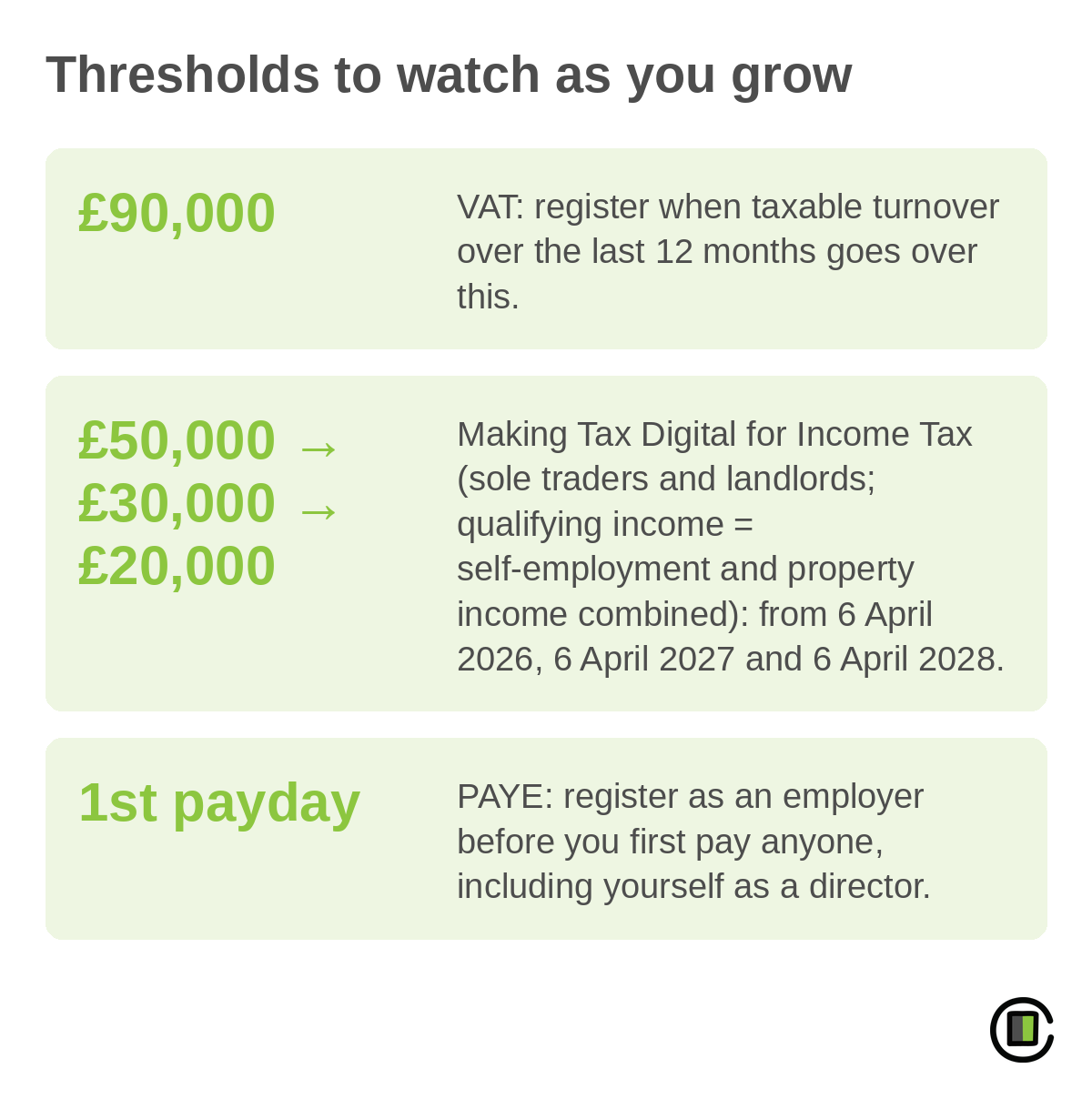
VAT. Register if your taxable turnover for the last 12 months goes over £90,000, or you expect it to in the next 30 days. If you went over, register within 30 days of the end of that month. Your effective date is the first day of the second month after you went over, or, if you expect to go over in the next 30 days, the date you realised. You account for VAT from that date. Voluntary registration is allowed below it. Keep VAT records for at least 6 years.
Making Tax Digital for Income Tax. Sole traders and landlords with qualifying income (self-employment and property income combined) over £50,000 (2024 to 2025) start from 6 April 2026; over £30,000 (2025 to 2026) from 6 April 2027; over £20,000 (2026 to 2027) from 6 April 2028.
PAYE. Register as an employer before your first payday, including a director paying themselves a salary. No earlier than 2 months before.
Step 6: Know your first year's deadlines
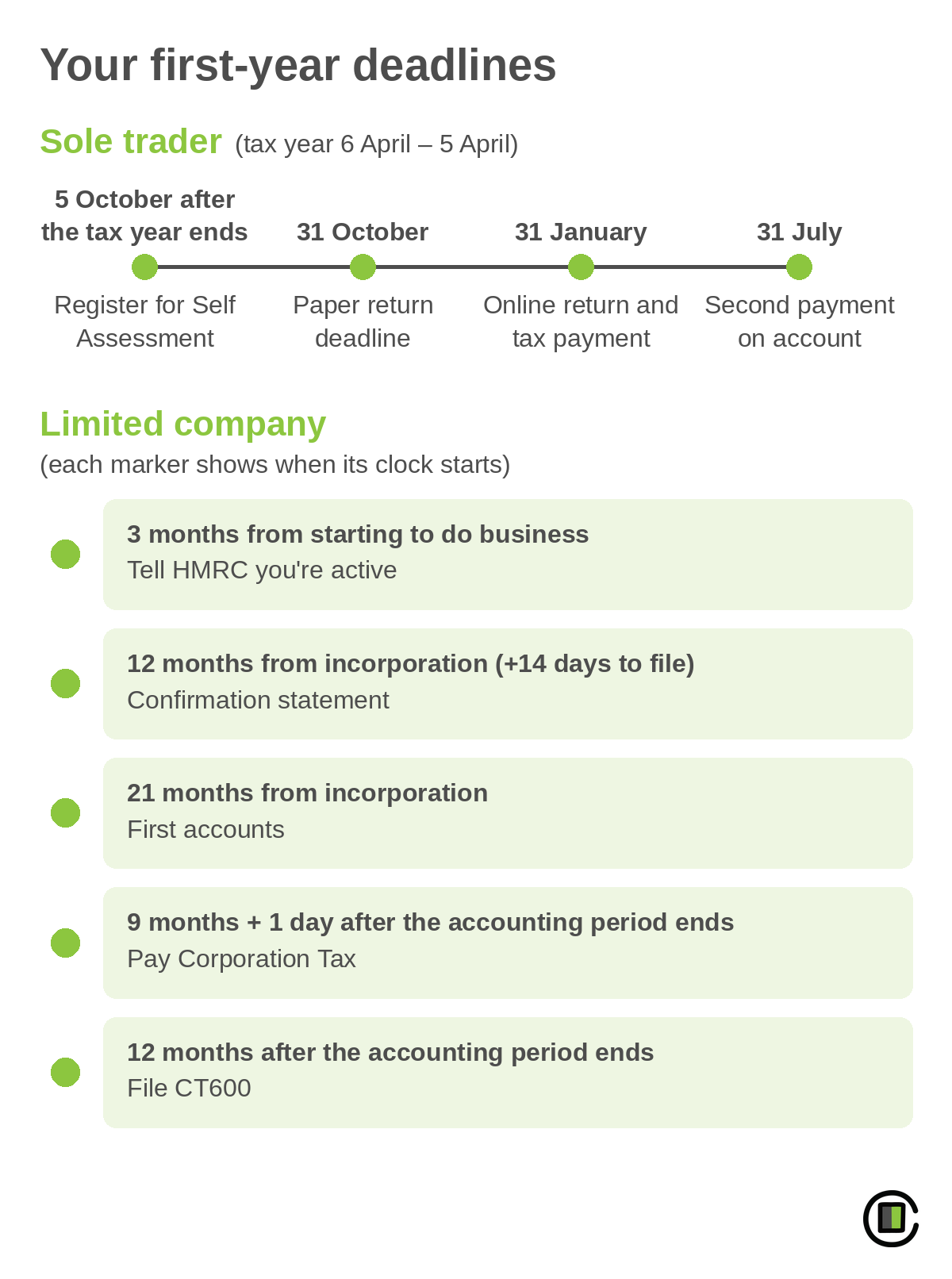
Sole trader
5 October: register for Self Assessment.
31 October: paper tax return deadline.
31 January: online return and tax payment.
31 July: second payment on account.
Each payment on account is half of last year's tax. None are due if that bill was under £1,000, or more than 80% was paid outside Self Assessment.
Limited company
Within 3 months of starting to do business: tell HMRC for Corporation Tax.
Every 12 months from incorporation: confirmation statement, with 14 days to file. You can be fined up to £5,000 and the company may be struck off if you do not file.
21 months after registration: first accounts to Companies House. After that, annual accounts are due 9 months after the company's financial year ends.
9 months and 1 day after the accounting period ends: pay Corporation Tax.
12 months after the accounting period ends: file the Company Tax Return (CT600), even if you made a loss.
How Codec Accounting can help
We cover all areas of accounting, working with small businesses and sole traders across Ealing, West London and London. We can:
Set out the sole trader and limited company options for your circumstances.
Handle your Self Assessment, Corporation Tax, PAYE and VAT registrations.
Set up bookkeeping that is ready for Making Tax Digital.
File your returns, accounts and confirmation statements on time.
Every step here has a deadline. Get them right in the first month and every year after runs on time.
Use our free MTD for Income Tax readiness checker to see when Making Tax Digital applies to you.
This article is general guidance, not advice for your specific situation. Requirements change, so check current guidance on GOV.UK.