
Codec Accounting – plain English accounting for charities, small businesses and sole traders in Ealing, West London and across London.
If your charity's accounts are late, you can catch up. Trustees in small charities are usually volunteers who juggle the role with jobs, families and the charity's actual work. A treasurer moves on, the bank statements pile up, and suddenly the deadline has passed.
This guide explains, in plain English, what your filing obligations are, what happens when you miss them, and a practical step-by-step plan to get back on track.
This article covers charities registered with the Charity Commission for England and Wales. Thresholds and rules change from time to time, so always check the latest guidance on GOV.UK.
What does your charity have to file?
What you have to file depends mainly on your charity's income and on whether it is also a company.
Charity Commission (all registered charities in England and Wales)
Every registered charity has to keep its details on the register up to date. Depending on income, it must also send the Commission:
Income of £10,000 or less: report your income and spending through the annual return service.
Income over £10,000: complete the full annual return online.
Income over £25,000: complete the annual return and upload your trustees' annual report, your accounts and, if your charity needs one, the independent examiner's or auditor's report.
CIOs are different: a charitable incorporated organisation must upload its trustees' annual report and accounts every year, whatever its income.
All charities must also prepare annual accounts and make them available to anyone who asks.
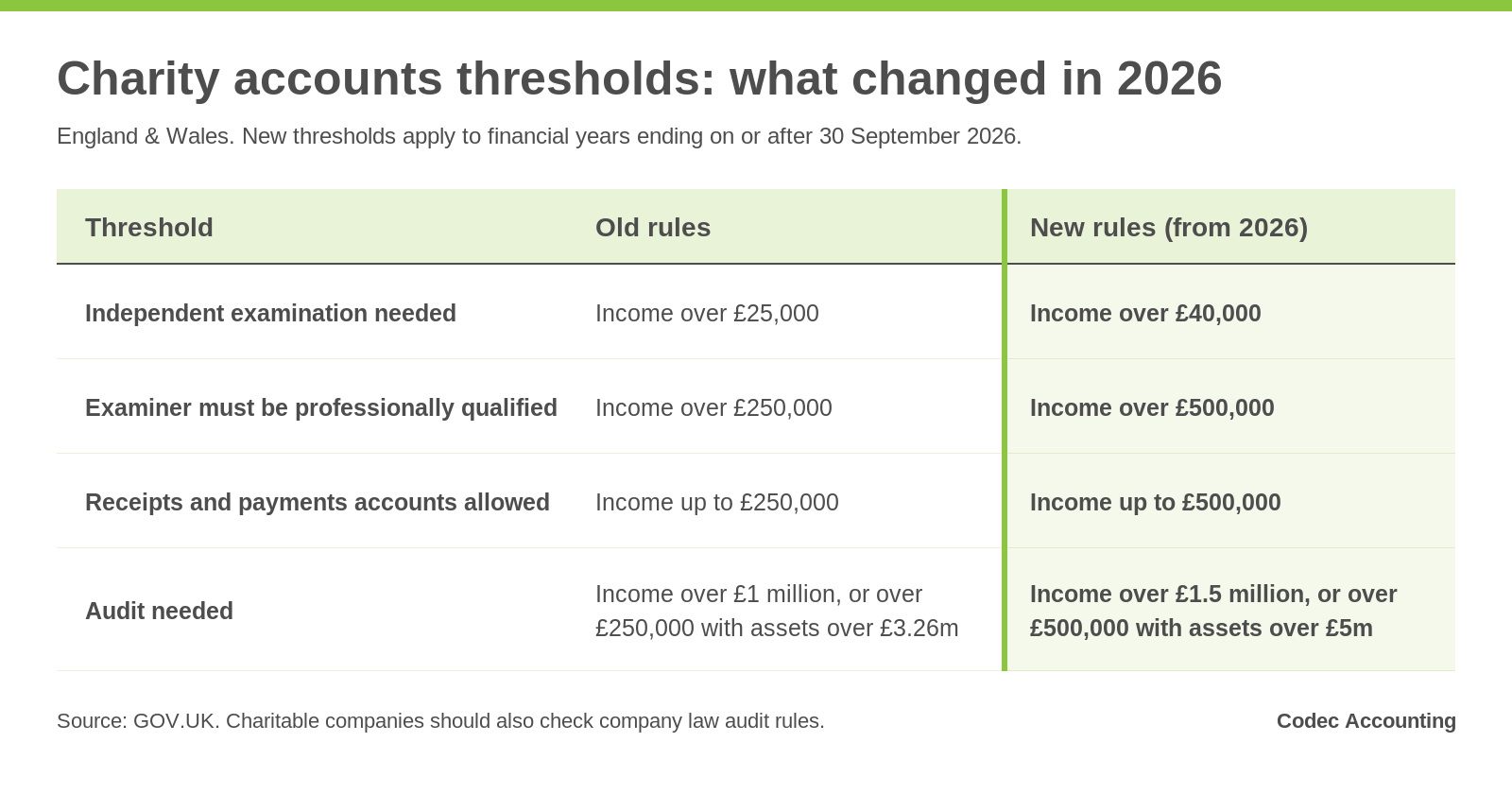
Thresholds changed in 2026. For financial years ending on or after 30 September 2026, the income levels for independent examination, audit and accruals accounts went up (see Steps 5 and 7). If you are catching up on older years, the old thresholds apply to those years.
The deadline is 10 months after the end of your financial year. So if your year ends on 31 March, everything is due by 31 January the following year. If it ends on 31 December, the deadline is 31 October.
Companies House (charitable companies only)
If your charity is also a limited company (for example, a company limited by guarantee), you must also file accounts at Companies House, normally within 9 months of the year end, and file a confirmation statement every year. CIOs (charitable incorporated organisations) file only with the Charity Commission.
What happens if you file late?
With the Charity Commission
Your charity is publicly flagged as late. The public register shows that your documents are overdue. Funders, grant-makers, banks and donors check the register, and an overdue flag can put them off.
Funding can be affected. Many funders want to see up-to-date filings before they award a grant.
Regulatory attention. Failing to file is a breach of trustees' legal duties, and the Commission can follow it up with the trustees and, in serious cases, take regulatory action.
Trustees are responsible. Filing is a legal duty of the trustees as a group, not just the treasurer.
The Commission does not normally issue automatic fines for late returns. The damage is mostly to your reputation, your funding and your relationship with the regulator.
With Companies House (charitable companies)
Companies House does issue automatic late-filing penalties, and being a charity does not exempt you. GOV.UK lists being a charity as a reason an appeal may not succeed. For a private company limited by guarantee, the penalty is:
Up to 1 month: £150
1 to 3 months: £375
3 to 6 months: £750
More than 6 months: £1,500
The penalty doubles if your accounts are late two years in a row. If you do not send Companies House your accounts or confirmation statement, the company can be fined and struck off the register.
Why charities fall behind
In our experience, the reasons are usually practical rather than careless:
The treasurer resigned and nobody took over the books.
Records are spread across spreadsheets, shoeboxes and personal email.
Trustees aren't sure which type of accounts they need.
The charity's income crossed a threshold and the requirements changed without anyone noticing.
One late year turned into two, and catching up felt overwhelming.
How to catch up: a step-by-step plan
Step 1: Find out exactly what is outstanding
Search for your charity on the Charity Commission register and see which years are showing as overdue. If you are a charitable company, check Companies House too. Write down each missing year and its deadline.
Step 2: Tell the trustees, and agree who leads
Late filing is a whole-board responsibility. Put it on the agenda, agree a timetable and choose one person to coordinate. A short minute recording the plan is useful evidence that the trustees are taking it seriously.
Step 3: Reply to the regulator promptly if they have written to you
If the Charity Commission or Companies House has written to you, reply promptly and explain your plan to catch up. Regulators generally respond better to charities that are open about a problem than to silence.
Step 4: Gather the records
For each outstanding year you will typically need:
Bank statements for every account (including savings and PayPal or other payment platforms).
Invoices and receipts for spending.
Records of income: donations, grants (including grant letters and any conditions), fundraising, trading and Gift Aid claims.
Details of any money given for a specific purpose (restricted funds).
The previous year's accounts, if any were prepared.
Lists of assets the charity owns and money it owes or is owed at the year end.
Incomplete records are common. Bank statements usually let you rebuild most of the picture, and banks can provide copies of older statements.
Step 5: Work out which type of accounts you need
Receipts and payments accounts are a simple summary of money in and out, plus a statement of assets and liabilities. Non-company charities and CIOs can usually choose this option if gross income is £500,000 or less (financial years ending on or after 30 September 2026) or £250,000 or less (earlier years), unless the governing document requires accruals accounts.
Accruals accounts follow the Charities SORP. They are required for charitable companies (whatever their size) and for other charities above those limits. SORP 2026 applies to financial years starting on or after 1 January 2026.
Choosing the right type early saves a lot of rework.
Step 6: Prepare the accounts, oldest year first
Work through the years in order, because each year's closing balances become the next year's opening balances. Alongside the accounts, the trustees prepare a trustees' annual report explaining what the charity did and how it was funded.
Step 7: Arrange the independent scrutiny you need
Your accounts need an independent examination or an audit if gross income is over £40,000 (financial years ending on or after 30 September 2026) or over £25,000 (earlier years), or if your governing document or a funder requires one. Above £500,000 (earlier years: £250,000), an independent examiner must be professionally qualified. An audit is required above £1.5 million income, or above £500,000 income with assets over £5 million (earlier years: £1 million, or £250,000 with assets over £3.26 million). Charitable companies should also check the company law audit rules. The independent examiner or auditor must be independent of the charity, and we can prepare the accounts and records they will review. Line up your independent examiner or auditor early, as they will need time. Accounts that are well prepared and properly supported make their job faster and cheaper.
Step 8: Get trustee approval and file
The trustees approve and sign the accounts and report. You then complete the annual return and upload the documents on the Charity Commission's online service (and file at Companies House if you are a company). Once you file, the register shows the date it was received, so a late submission will still show as late. But the charity is no longer overdue.
Step 9: Put systems in place so it doesn't happen again
Diary the filing deadlines for every year.
Use simple cloud bookkeeping software so records are kept as you go.
Do a quick monthly or quarterly bank reconciliation.
Make sure more than one trustee can access the charity's records and bank accounts.
Plan a handover in case your treasurer steps down.
Common questions
Will the Charity Commission fine us? The Commission does not have an automatic late-filing penalty like Companies House's, but late filing is publicly visible and it can take regulatory action. Charitable companies do receive automatic penalties from Companies House.
We're several years behind. Do we have to do every year? In general, yes. The Commission expects every outstanding year's return and documents to be filed. If you are unsure what applies to you, contact the Commission or get professional advice.
Our income is under £10,000. Do we need to do anything? Yes. Unless you are a CIO, you just report your income and spending through the annual return service each year. (CIOs file a full return with accounts.) You must also keep your register details up to date and prepare accounts for anyone who asks for them.
Can a volunteer treasurer do this? Often, yes, especially for receipts and payments accounts. Many charities do the first catch-up with professional help, then keep it going themselves.
How Codec Accounting can help
We cover all areas of accounting, but we have deeper skills and experience with charities. We work with charities across Ealing, West London and London, as well as remotely across the UK. We can:
Review what's outstanding and give you a clear catch-up plan and a fixed fee.
Rebuild your records from bank statements and whatever paperwork you have.
Prepare receipts and payments or SORP-compliant accruals accounts, ready for your trustees and for your independent examiner or auditor.
Help you set up simple cloud bookkeeping so you stay on track.
Use our free charity filing deadline calculator to check your next deadlines.
This article is general guidance, not advice for your specific situation. Requirements change, so check current guidance on GOV.UK.